
Nelson Laizer, Founder & Travel Designer
Why Your Safari Guide Matters More Than Your Lodge
Why the guide shapes a Tanzania safari more than the lodge: what a great guide does, how guides are licensed in Tanzania, your own guide vs camp guides, and the questions to ask before you book.

Reviewed November 2026 by the Emnel team in Arusha.
The short answer: On a Tanzania safari, your guide shapes the experience more than your lodge does. You spend most of your waking hours in the vehicle, and it is your guide who finds the animals, positions you for the sighting, reads what the herds will do next, keeps you safe, and explains what you are seeing. A beautiful lodge cannot make up for a guide who rushes, crowds sightings or simply drives from one to the next. If your budget forces a choice, we would always recommend an experienced private guide and a well-placed mid-range camp over a famous lodge with a shared vehicle.
This is the part of a safari that brochures rarely show, and the one our guests talk about most when they come home. It is also why Emnel works the way it does: the team that plans your safari in Arusha is the team that guides it. This guide explains what a great safari guide actually does, how guides are licensed in Tanzania, the questions to ask before you book, and what our guests say about the guides who looked after them.
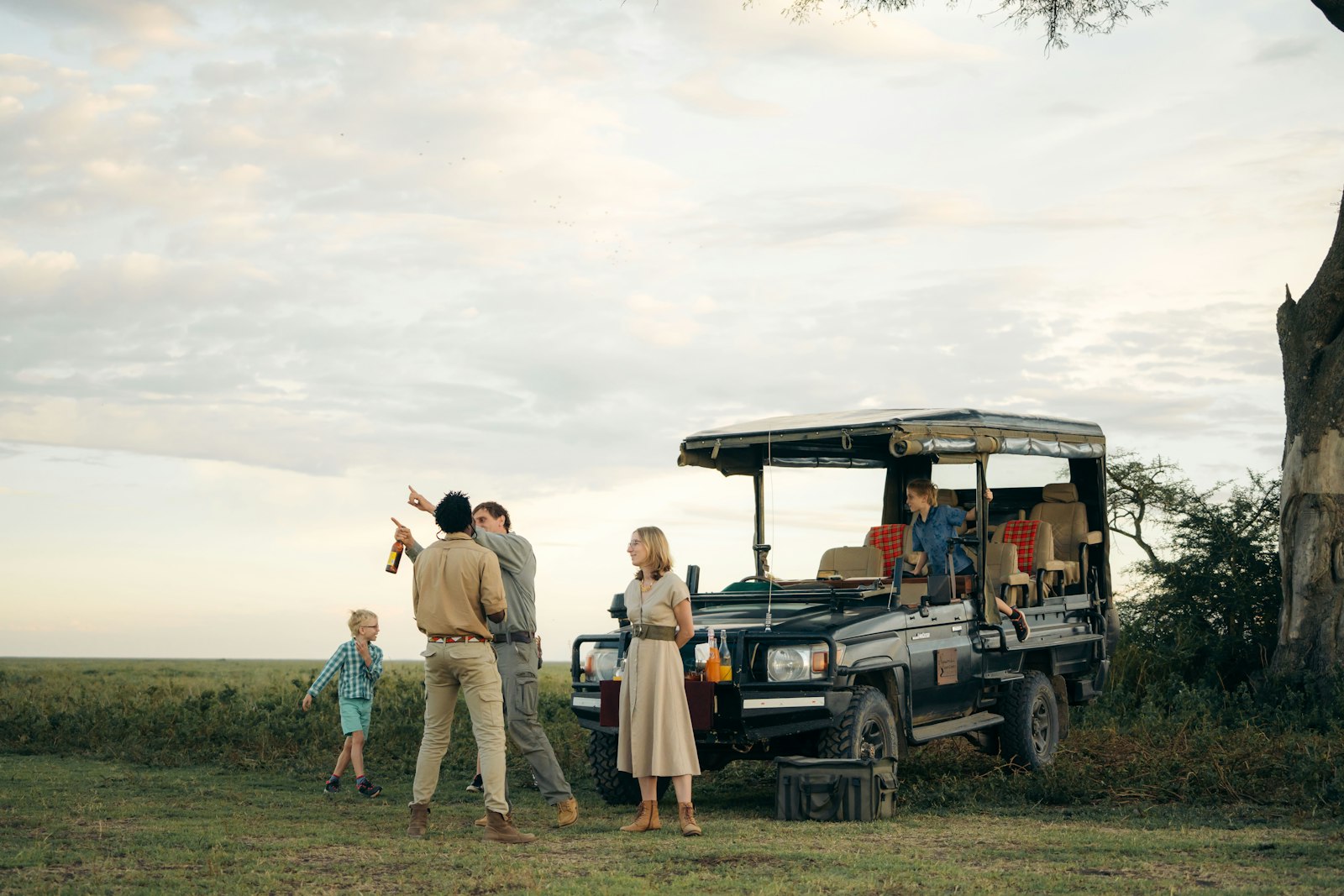
What a great safari guide actually does
What the guide does | What it means for you |
|---|---|
Finds the animals | Reading tracks, alarm calls, circling vultures and the behaviour of other animals, rather than following the crowd |
Positions the vehicle | The best angle and light for photographs, without disturbing the animal or blocking other guests |
Predicts what happens next | Waiting at the right bend of the river before a crossing, or by a waterhole before the lions come to drink |
Explains what you are seeing | Why a cheetah hunts in the heat of the day, how a herd chooses its crossing point, what the Maasai call a particular tree |
Keeps you safe | Knowing how close is too close, how an elephant shows it is uneasy, and when to move on |
Runs the day | Gate times, park fees, routes, timing the crater descent, and finding a quiet spot for a bush breakfast |
Reads you | Noticing that a child is tired, that a photographer wants to wait, or that a couple would rather have a sighting to themselves |
Why your guide matters more than your lodge
On a typical safari day you leave camp early, spend much of the day on game drives, and return in time for a sundowner and dinner. The lodge is where you sleep, eat and rest. The guide is with you for the moments you travelled for.
The same park, a different safari. Two vehicles can drive the same road on the same morning; one sees a leopard, the other does not. The difference is usually the guide.
Crowds are managed, not avoided by luck. An experienced guide knows when to arrive at a sighting, when to leave, and which loops stay quiet when everyone else is in one place.
Understanding turns a sighting into a story. Knowing why the herds move, or how a lioness raises her cubs, is what guests remember years later.
Continuity matters. With your own guide for the whole journey, they learn what you love by the second day and plan the rest around it.
This is why we only plan private safaris: your guide and vehicle are yours alone, so the day can follow your interests. Our guide to private vs group safaris explains the difference in detail.
How safari guides are licensed in Tanzania
Tanzania requires safari guides to hold a licence, and the basic requirements are a certificate from a recognised training institution in tour guiding, guiding experience, first-aid training and a valid driving permit. Many guides train at the College of African Wildlife Management at Mweka, one of the region's best-known wildlife colleges.
What Tanzania does not yet have is a graded national system like those used in South Africa or Kenya, where guides move through recognised levels of experience. In practice, that means the quality of guiding varies widely from one company to the next, and the guide's experience, training and attitude depend on the operator who employs them. It is worth asking about.
Your own guide, or a camp's guide?
Most Tanzania safaris use a driver-guide: one guide who drives your private vehicle and travels with you from park to park for the whole safari. The alternative is to fly between camps and use each camp's own guides and vehicles.
Your own private guide | Camp-based guides | |
|---|---|---|
Continuity | The same guide all trip, who learns what you love | A new guide at each camp |
Flexibility | Your day, your pace, your route | Set activity times, often shared vehicles |
Local knowledge | Broad knowledge across all the parks on your route | Deep knowledge of one area |
Best for | Families, first safaris, photographers, multi-park routes | Fly-in safaris and private reserves with walking and night drives |
The two can be combined. On a longer journey, many of our guests travel with their own Emnel guide through Tarangire, the Ngorongoro Crater and the Serengeti, then add a few nights in a private reserve such as the Singita Grumeti concession for walking safaris and night drives with the camp's own guides.
Why Emnel's guides are our own
Emnel is run by a small founding team of Tanzanian-born guides, all based in Arusha and all part of the company since its early years. Our senior guides, Rahim Maghimbi, Gabriel Sanguyan and Ally Msemo, guide in English, and Prince Charles guides in German and English. We do not pass our guests to subcontracted drivers, and we do not run shared group tours.
That means the people who plan your route know every road, camp and crossing point on it, because they drive them. When you ask whether a camp is right for your children, or which side of the river to wait on in August, you are hearing from people who have been there. Read more about our team.
What our guests say about their guides
When guests write to us after a safari, the guide is almost always the first person they mention.
“We had the most amazing experience booking our honeymoon safari through Nelson, and couldn't recommend him enough! … We also have to give a special mention to our safari guide, Joachim, who was absolutely incredible!”
— Gemma E, honeymoon couple, 10-Day Tanzania Honeymoon Safari & Zanzibar
“As a female solo traveler, I felt safe, comfortable, and cared for throughout the entire trip. … A special shoutout to Josh, my guide — the true captain of my safari. He treated me like family, shared countless stories, and taught me so much about wildlife.”
— Sujana H, solo traveller, 7-Day Serengeti Safari & Zanzibar
“… There is no doubt that the real success of the trip was down to our fantastic guides Gabriel and Abasai.”
— Melanie W, family of four, 8-Day Tanzania Family Safari
Before you book: questions to ask about your guide
☐ Who exactly will guide us, and can you tell us about them?
☐ How many years have they guided in the parks on our route?
☐ Are they licensed, and do they hold a current first-aid certificate?
☐ Will the same guide stay with us for the whole safari?
☐ Is the vehicle private to us, with a pop-up roof and a window seat for everyone?
☐ Which languages do they guide in?
☐ Do they employ their guides directly, or subcontract them?
Our full guide to choosing a safari operator in Tanzania covers the other questions worth asking.
Where to spend if your budget has limits
If you have to choose, spend on the guide and the vehicle first, then on the location of your camps, and only then on the luxury of the rooms. A private safari with an experienced guide at a well-placed Mid-Luxury camp will usually give you a better safari than a shared vehicle from a famous lodge. Our guides to what a Tanzania safari costs and how many days you need show how to shape a safari around your budget.
How we keep this guide current
We review this guide each year, alongside the licensing requirements for Tanzanian guides and the latest reviews from our guests. Last reviewed: November 2026.
Frequently asked questions
Does the safari guide really make a difference?
Yes. Your guide decides where you go, how long you stay at each sighting, how you are positioned and how much you understand. On the same road on the same morning, a great guide and an average one can give two very different safaris.
Are safari guides in Tanzania licensed?
Yes. Guides must be licensed, with a certificate from a recognised training institution, guiding experience, first-aid training and a valid driving permit. Many train at the College of African Wildlife Management at Mweka.
Will I have the same guide for my whole safari?
On a private Emnel safari, yes. Your guide stays with you from the first game drive to the last, unless you choose to add a fly-in camp or private reserve that uses its own guides.
Is it better to spend money on the guide or the lodge?
On the guide and vehicle first. A private guide with a well-placed Mid-Luxury camp usually gives a better safari than a shared vehicle from a famous lodge.
What languages do Emnel's guides speak?
All our guides guide in English, and Prince Charles also guides in German. Ask us if you need another language.
How much should I tip my safari guide?
Tipping is personal and appreciated rather than expected. We include clear guidance in your pre-departure pack, so you know what is customary before you travel.
Plan your safari with the team who guide it
Tell us when you would like to travel and who is coming, and we will reply within 24 hours with a personal route, named camps and a clear, all-inclusive price. Every journey is planned in Arusha and guided by the team who will be with you on the ground.
Prefer to talk it through first? Contact our team in Arusha.