
Great Migration Tanzania: Complete 2025–2026 Guide
- May 30
- 9 min read

The morning I remember most clearly from the Mara River happened in October. We had been waiting since six, our vehicle positioned on the bank, the valley below perfectly still. Then, around nine, the first wildebeest appeared on the ridge opposite. Within twenty minutes there were thousands of them — pressing forward, pulling back, pressing again. The crocodiles were already in the water. That's the thing about the crossing that surprises most guests: the animals know the risk. The hesitation before the plunge is real. When the first one commits, the rest follow in a chaos of hooves and spray that lasts minutes and then, as suddenly as it began, stops.
The Great Migration in Tanzania is the largest overland movement of wildlife on earth — approximately 1.5 million wildebeest, 200,000 zebras, and 500,000 gazelles moving in a continuous annual circuit through the Serengeti-Mara ecosystem. There is no single start date and no finish line. It runs year-round. What changes, month by month, is where the herds are and what they are doing when they get there.
This guide tells you exactly that.
What Is the Great Migration in Tanzania — and Why Does It Happen?
The migration is driven by rainfall and grass. As the short rains arrive in the southern Serengeti each November and December, the short-grass plains around Ndutu fill with new growth – nutritionally rich in the minerals that pregnant wildebeest need. The herds move south, calve, and fatten on those pastures. As the land dries through March and April, they begin a clockwise sweep northward through the western and central Serengeti, eventually reaching the Mara River in Tanzania's far north before completing the loop back south.
It is not a straight-line march. The herds scatter, merge, double back, and split across landscapes that shift from open plains to dense woodland to river thicket. A column thirty kilometres long can disappear into acacia scrub and re-emerge two ridges over. What makes Tanzania the heart of this spectacle is that the majority of the circuit — calving, the Grumeti River crossing, the long push north, and the return — unfolds entirely within the Serengeti ecosystem, which covers 14,763 square kilometres of protected land.
The Mara River itself, where the most celebrated crossings occur, runs through Tanzania's Northern Serengeti before crossing into Kenya. This matters: you can witness every phase of the migration — from calving season to river crossing to the return south — without leaving Tanzania.
Great Migration Calendar: Month-by-Month for 2025–2026

No two years are identical. Rainfall timing shifts the herds by days or weeks, and experienced guides track herd movement in real time rather than relying on fixed dates. The following is a reliable framework, not a timetable.
January – March: Calving Season, Southern Serengeti & Ndutu
The short-grass plains around Ndutu and the Ngorongoro Conservation Area are where roughly 500,000 calves are born in a window of six to eight weeks – sometimes compressed into a single month. A wildebeest calf can stand within minutes and run within hours. It needs to be: cheetah, lion, and spotted hyena density in Ndutu during calving season is among the highest recorded anywhere in Africa. For those interested in wildlife behaviour — predator interactions, the mechanics of birth, and the visible social logic of herd life — this is arguably the most compelling period of the entire annual cycle.
Crowd levels are moderate. Ndutu is remote and rewards guests who come with a knowledgeable guide rather than a fixed schedule.

April – May: The Long Rains and Westward Movement
The herds begin shifting northwest toward the Western Corridor and the Grumeti River as Tanzania's long rains arrive. This is green season: rich landscapes, dramatic cloud formations, and very few other vehicles. Some roads in the western Serengeti become challenging after heavy rain. Experienced travellers who prioritise space and exclusivity over peak wildlife concentration often choose this period deliberately. Lodge rates drop considerably.
June – July: Grumeti River Crossings, Western Serengeti
The first major crossings of the year happen at the Grumeti River — narrower and less dramatic in scale than the Mara but deeply impressive, with resident Nile crocodiles that have grown to exceptional size in a river that sees almost no fishing pressure. The Western Corridor is less visited than the north, and because the herds are still building momentum, game drives here often combine crossing opportunities with excellent big cat encounters across the open plains.
August – October: Mara River Crossings, Northern Serengeti
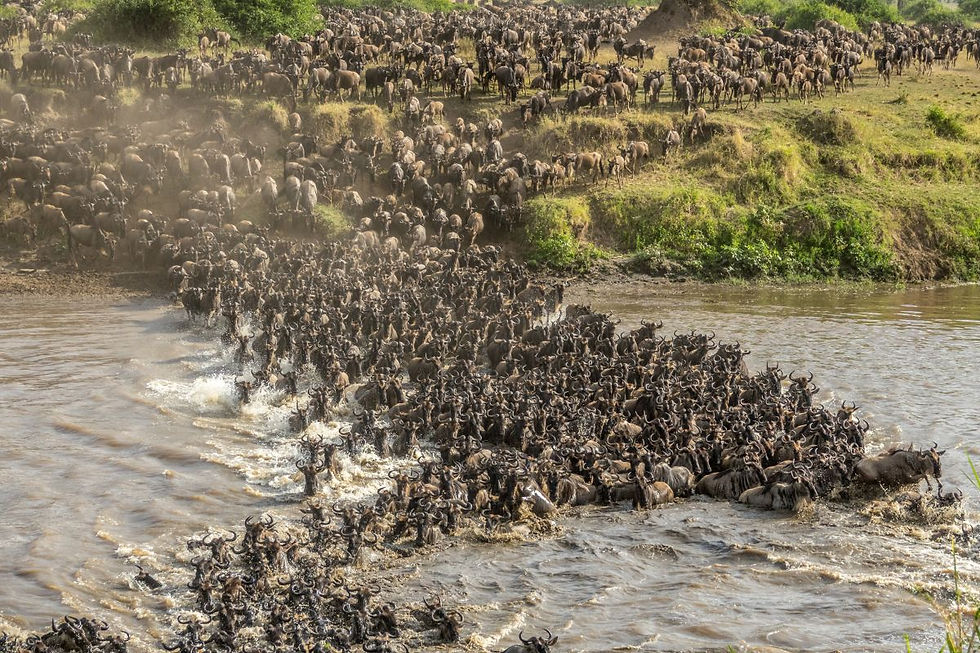
This is the phase most travellers are thinking of when they search for the great migration in Tanzania. The herds mass on the southern bank, pace and retreat for hours — sometimes days — before the first animal commits. When the crossing triggers, thousands plunge simultaneously into water patrolled by enormous crocodiles, navigating steep muddy banks and unpredictable currents. Not every attempt succeeds cleanly. The drama is inseparable from the uncertainty.
August through October is peak season. Camps on the Lamai Wedge and along the Kogatende corridor place guests within reach of the primary crossing points. The best-positioned properties fill nine to twelve months in advance.
November – December: The Return South
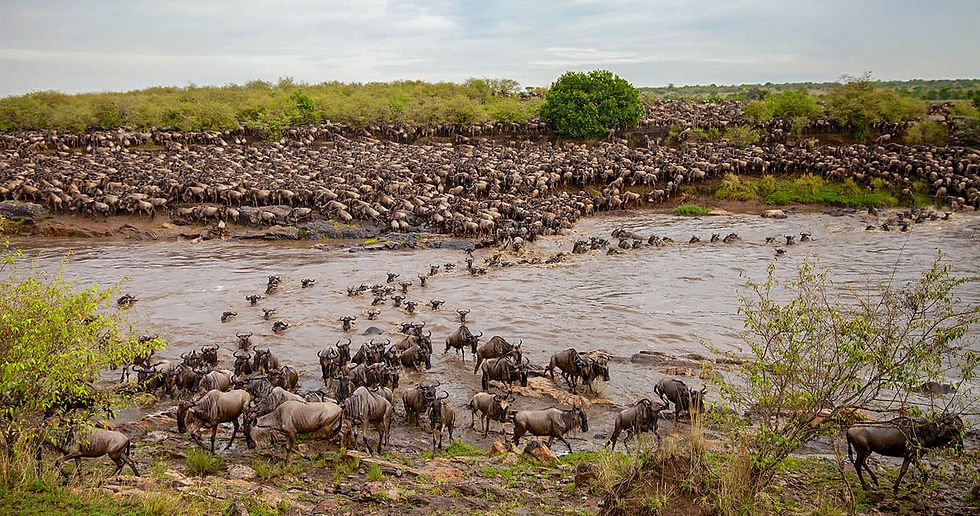
The short rains draw the herds back toward Ndutu and the southern plains. The northern Serengeti empties quickly; the southern short grass begins filling again. This transitional period offers excellent general game viewing across the central Serengeti and is a practical window for first-time visitors — solid wildlife, improving lodge availability, and the beginning of another calving cycle by late December
Where to Be: The Four Zones That Define Migration Positioning
Witnessing the migration is fundamentally a question of positioning. Knowing the right month is necessary but not sufficient — you need to be in the right zone, with a camp that reduces drive time to the action rather than adding to it.
Ndutu and the Southern Plains (January – March) The dispersed short-grass plains around Ndutu Safari Lodge and the mobile camps operating within the Ngorongoro Conservation Area form the best base for calving season. Drives cover wide open ground — essential for spotting cheetahs at a distance and tracking predator activity around newborn animals. The landscape here looks nothing like the classic Serengeti; it is flatter, more intimate, and often thick with wildebeest as far as you can see.
The Western Corridor (June – July) The area around the Grumeti River covers the first crossing zone. Camps like Grumeti Serengeti Tented Camp and mobile operators positioned in the corridor offer access to crossings with far smaller crowds than the north. The park roads here are less trafficked, and the birdlife in the riverine forest is exceptional.
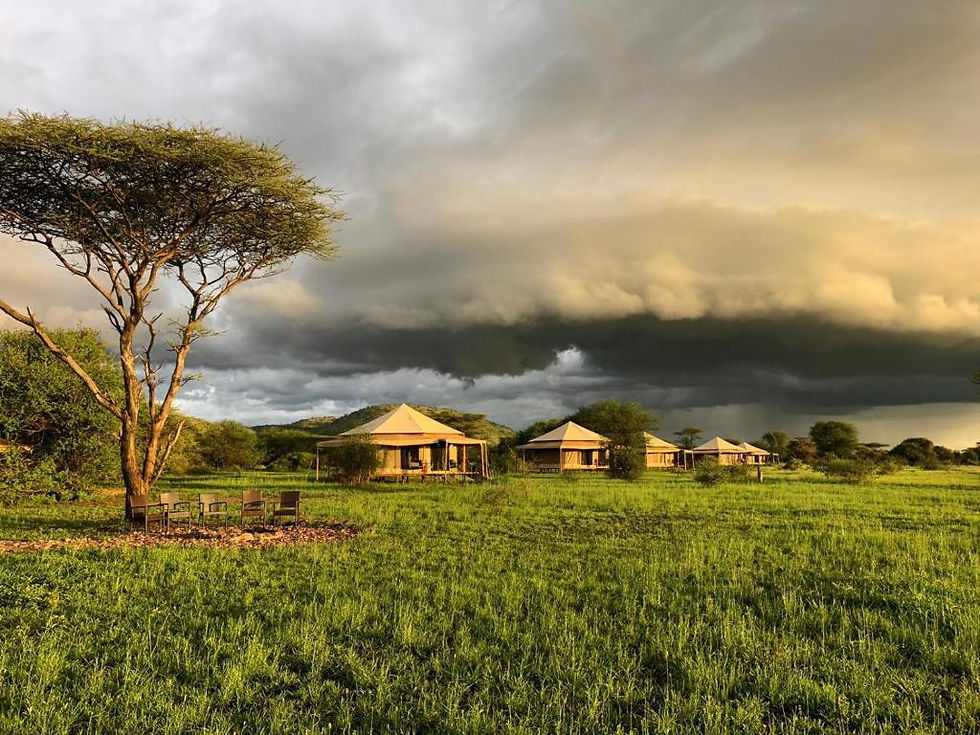
Central Serengeti (year-round) Seronera and the central plains are productive in every month — resident lion prides, leopard in the sausage trees along the Seronera River, and a reliable concentration of plains game that does not depend on migration timing. For multi-park itineraries, a centrally positioned camp such as Serengeti Serena or Four Seasons Serengeti offers maximum flexibility. This is also the best base for guests who want the Serengeti without committing their entire trip to the crossing.

Northern Serengeti — Lamai and Kogatende (August – October) The Lamai Wedge — the narrow corridor of land between the Mara and Sand rivers — is the premium position for river crossing season. Access is typically by short flight from Arusha or from Seronera. Camps including Lamai Serengeti, Alex Walker's Serian, and several well-run mobile operations offer front-row positioning at the main crossing sites. This is the most in-demand real estate in Tanzanian safari and requires the most advance notice.

How to Plan a Great Migration Safari in Tanzania — Honestly
A few things we tell every guest before they book.
The crossing is not guaranteed. The Mara River crossing is the most-requested wildlife event in East Africa and also the least predictable. Herds can sit on the bank for four days and cross overnight, or cross three times in a single afternoon. You increase your odds by staying longer — a minimum of three nights in the northern Serengeti gives you a realistic chance. One-night itineraries often miss it entirely, not through bad planning but because the migration doesn't follow anyone's schedule.
Position matters more than brand. A well-placed mobile camp twenty minutes from the primary crossing points will outperform a luxury lodge two hours away every time. When we build itineraries at Emnel Adventures, we choose properties based on current herd positioning, not on name recognition. Our wildebeest migration safari packages are built around travel dates first and lodges second — always.
Your travel window determines everything. A guest arriving in February needs a completely different itinerary from one coming in September. The Serengeti is not a single experience — it is a sequence of distinct ecosystems that each come alive at different points in the annual cycle. The most important detail you can share when planning is your dates.
Multi-park itineraries require careful construction. Ngorongoro Crater is a logical addition for almost any Serengeti routing — it adds dense resident wildlife, a radically different landscape, and an experience that works in any month. Tarangire National Park is at its best from June through October, when dry season concentrates large elephant herds around the river. Getting the balance right means understanding how road time affects actual time spent in the field.
For families who want to witness the migration, the calving season (January–March) is often the most practical choice: shorter drives, a compact base at Ndutu, and the spectacle of newborn animals that resonates with children of almost any age. Our Tanzania family safari page outlines how we structure these trips around different age groups and energy levels.
If you are starting from scratch, a tailor-made migration safari is the most effective approach. Tell us your dates and what you want to prioritise — we handle the rest.
Nelson's Note
I have been at the Mara River more times than I can count, and it humbles me every time. What I have learned is that it humbles everyone equally — guests on their first safari and guides who have been doing this for twenty years. You cannot script it. I have had clients wait three days and see nothing, then watch six crossings on the fourth morning before breakfast. I have had guests witness a crossing within forty minutes of reaching the bank. Both groups leave with the same expression.
What I know from experience is that positioning matters more than almost any other decision. I will not put a guest in a camp that takes two hours to reach the river crossing points at the cost of their morning light. I would rather they stay somewhere modest and close than somewhere prestigious and distant. The other thing I always say: do not let the crossing be the only thing you are chasing. The Serengeti in August is extraordinary whether you see a crossing or not — the predator density, the quality of afternoon light, the silence between sightings. Build the safari around the ecosystem, not just the moment. The crossing, if it comes, becomes the centrepiece of a journey that was already going well.
Frequently Asked Questions About the Great Migration in Tanzania
When is the best time to see the Great Migration in Tanzania?
The migration is a year-round event, but the best time depends on what you want to see. For Mara River crossings — the most dramatic phase — August through October gives the highest probability. For calving season with intense predator activity, January through March in Ndutu is the right period. The Grumeti River crossings in June and July are excellent if you prefer smaller crowds. There is no single best month — only the month that best matches your priorities and travel dates.
Where exactly do the Mara River crossings happen in Tanzania?
The primary crossing sites are in the Northern Serengeti, in the area around Kogatende and the Lamai Wedge. The Mara River runs through Tanzania's Northern Serengeti before crossing into Kenya; the crossings most accessible to safari guests take place on the Tanzanian side, at sites including the Lookout Hill area and several documented crossing points along the riverbank south of the Kenyan border.
Do I need to travel to Kenya to see the Great Migration?
No. The complete annual cycle — calving, Grumeti crossings, Mara River crossings, and the return south — is accessible within Tanzania's Serengeti National Park and the Ngorongoro Conservation Area. The herds do cross briefly into Kenya's Masai Mara each year, but Tanzania provides access to all key phases without leaving the country.
How long should I spend in the Serengeti to see the migration?
For Mara River crossings, a minimum of three nights in the Northern Serengeti is strongly recommended. One or two nights significantly reduces your chances of witnessing a crossing. For calving season, two nights at Ndutu is generally sufficient. A multi-zone migration safari covering two or more phases of the annual cycle typically runs seven to ten days.
How far in advance should I book a migration safari in Tanzania?
For the Mara River crossing season (August–October), book nine to twelve months in advance. The best-positioned camps in the Northern Serengeti fill early and do not hold space for long. For calving season (January–March) and the Grumeti crossings (June–July), four to six months' lead time is generally sufficient — though earlier booking always improves your selection of properties.
Can families with young children see the Great Migration?
Yes. The calving season (January–March) is often the most suitable for families — shorter drives from a central base at Ndutu, and the spectacle of newborn wildebeest and active predators that holds children's attention without the long waits that river crossing season can involve. The Mara River crossing season (August–October) works well for older children and teenagers who are comfortable with open-ended timing and full-day game drives.
If you are planning a migration safari and want advice matched to your exact travel dates, we are based in Arusha and respond to all enquiries within 24 hours. Start the conversation here, or reach us directly on WhatsApp.
